


2025 Resuscitation Guidelines - What you need to know.

The Resuscitation Council UK (RCUK) has published its 2025 Resuscitation Guidelines. These evidence-based guidelines will be implemented throughout 2026, bringing changes to both first aid training and call handler training programmes. Here's everything you need to know about what's changing—and what's staying the same.
Don't Let Change Stop You from Acting
If you hold a valid first aid certificate, there's no need to worry. The training you received is still valid, and you should continue to perform CPR exactly as you were taught. Even though new guidelines have been published, it is completely acceptable—and potentially life-saving—to perform CPR using the techniques from your training.
The most critical thing to remember is this: the worst thing you can do in an emergency is to hesitate or not act at all because you're worried about doing something "wrong" or because someone tells you the guidelines have changed. The fundamentals of adult CPR haven't changed—it's still 30 chest compressions to 2 rescue breaths. Your willingness to act and provide immediate care is far more important than worrying about minor procedural updates.
Confidence saves lives. Trust your training and take action.
What's New in the 2025 Resuscitation Guidelines
The guidelines are much farther reaching than just how CPR is taught on a first aid course! These updated guidelines are designed to improve survival, strengthen emergency care systems, and ensure consistent, high-quality training and practice across the four nations. They provide a single, trusted evidence base to support healthcare professionals, educators, and responders. [https://www.resus.org.uk/about-us/news-and-events/rcuk-publishes-guidelines-2025] For full information you should visit the RCUK's website.
The key updates affecting first aid training are:
- First aid: A new section focused on bystander response, with updated guidance for emergencies including bleeding, choking, overdose, stroke, and trauma.
- Basic life support in community settings: Updated advice on when to call 999 and how to get an AED. N.B. there are NO changes to the ratio of 30 compressions : 2 rescue breaths. However, it is VERY interesting that this algorothm is now for basic lief support in the community. I believe that this gives training providers the leeway to adapt the protocol when cardiac arrest has not taken place 'in the community', for example, if you are in a remote environment. It is vital to be able to adapt training to suit the environment of those being trained.
- Paediatrics: Updated hand positioning for infant CPR.
- Special circumstances guidelines: - especially important for our outdoor first aid training and sports first aid training courses. [https://www.resus.org.uk/professional-library/2025-resuscitation-guidelines/special-circumstances-guidelines]
- Traumatic peri-arrest and cardiac arrest - a new protocol in which rescuers might be advised to give CPR in a peri-arrest situation while they treat traumatic injuries. This is a VERY interesting addition as we are often training people who work or play in envirnoments where traumatic injury could happen.
- Cardiac arrest in sports - Assume cardiac arrest if collapsed during, or just after sport.
Download 2025 Individual Resuscitation Guidelines
2025 Guidelines - Adult BLS in the community
https://www.reactfirst.co.uk/download-file.htm?id=74&pos=0&dir=downloads
2025 Guidelines - Adult Choking
https://www.reactfirst.co.uk/download-file.htm?id=75&pos=0&dir=downloads
2025 guidelines - Paediatric BLS out of hospital
https://www.reactfirst.co.uk/download-file.htm?id=77&pos=0&dir=downloads
2025 Guidelines - Paediatric Choking
https://www.reactfirst.co.uk/download-file.htm?id=78&pos=0&dir=downloads
2025 Guidelines - Traumatic Cardiac Arrest
https://www.reactfirst.co.uk/download-file.htm?id=76&pos=0&dir=downloads
We are pleased to see specific guidance included about bras: Removing a bra before defibrillation: Rescuers should prioritise correct pad placement and contact with bare skin. If this can be quickly achieved without removing the bra, then it is acceptable to keep the bra in place. If the bra interferes with correctly locating the pad position, then the bra should be removed. Rescuers should not be concerned about exposing the person's chest to apply the pads and should prioritise life-saving interventions. [Ref: https://www.resus.org.uk/professional-library/2025-resuscitation-guidelines/adult-basic-life-support-guidelines]
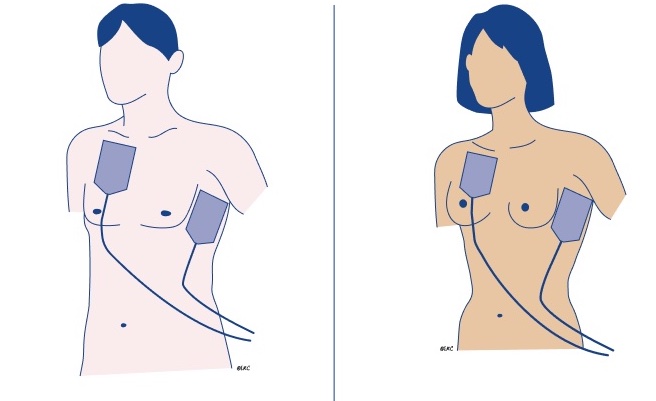
It is well-known that rescuers are more hesitant to start CPR on a female as they don't wish to expose their chest. In 2024 St John Ambulance launched a CPR Bra campaign to tackle gender disparity in CPR with the headline: One in three afraid to give CPR to a woman in public! [Ref: https://www.sja.org.uk/press-centre/press-releases/St-John-launches-CPRbra-campaign-to-tackle-gender-disparity-in-cpr/]
Why Adult and Paediatric CPR Differ
The new guidelines also provide clear information to understand why there are different guidelines for Adult and Paediatric CPR. If you have any doubt about the ratio of compressions to rescue breaths just go with 30:2, it is never wrong, there are only improvements depending on the level of training and the numbers of rescuers.
Firstly, let's just cover off the terminology:
- Paediatrics: Under 1 year = infant, 1-12 years = child, 13-18 years = adolescent. There is an update to the terminology used to break down the different age groups and alterations to treatments in Paediatric BLS guidelines.
Differing Causes of Cardiac Arrest
- Adults typically experience cardiac arrest due to heart-related problems, usually a heart attack.
- Children more commonly experience cardiac arrest as a result of respiratory issues (breathing problems) that then lead to the heart stopping.
- Infants are particularly vulnerable to airway obstruction from choking.
Because of these different causes, the approach to resuscitation differs between age groups.
Key Differences in Technique
Compression Depth
- Depress the chest by at least one third of the anteroposterior dimension.
- Use the adult depth recommendation of 5-6 cm in adolescents.
- Do not exceed a depth of 6 cm at any age.
Hand Placement and Technique
- Adults: Both hands interlaced, heel of hand on the centre of the chest
- Children: Use the one-hand or two-hand technique in children older than 1 year, or when unable to give high-quality chest compressions with the two-thumb-encircling technique.
- Infants: Use the two-thumb encircling method for chest compressions in infants , THIS HAS BEEN UPDATED, previously the guidance was two fingers on the lower half of the breastbone
When to Call for Help
- Adults: Call 999 as soon as you establish that the casualty is unresponsive, then start CPR
- Children and Infants: If you're alone, perform CPR for 2 minutes first, then call 999. It is most likely that the casue of cardiac arrest is related to a lack of air, hence the need to give 5 rescue breathes. Rescue breaths are more critical because their cardiac arrest is usually caused by breathing problems, meaning they need oxygen urgently!
2026 Resuscitation Guidelines Implementation Timeline
The new guidelines will be rolled out during 2026. The Resuscitation Council UK recognises that updating training practices is a significant undertaking and is encouraging organisations to begin preparing for these changes now, to roll out over the next 12 months.
Where We Are Now (Nov 2025): At the moment, React First is waiting for guidance from our awarding organisation, ITC First, who are working on a timeline for updated resources. We take our lead from when they will want these new resources and training protocols to be implemented, at which time we'll update our own training resources like slide presentations and run standardisation sessions for our trainers.
For training organisations like React First, the implementation process involves several important stages:
Review Phase: Training organisations and awarding organisations must first conduct a thorough review to establish exactly what has changed in the guidelines and how these changes affect the protocols currently taught on first aid courses.
Materials Development: Once the changes are understood, new protocols and training materials need to be developed. This happens at different speeds, with some materials being developed by the awarding organisation and others by React First ourselves. Digital materials like protocols and PowerPoint slides can be updated more quickly, while printed manuals take longer to revise, produce, and distribute.
Trainer Standardisation: Once the changes are understood and new materials have been prepared, we will then organise trainer standardisation sessions to ensure that all our trainers are familiar with both the new guidelines themselves and the specific changes to how training is delivered. This ensures consistency and quality across all training programmes.
It's a big job! The RCUK understands that this comprehensive process takes time—typically it can take a year for full implementation.
Return to First Aid Tips List
Share this Tip
More Tips
- Continuing to raise the standard of sports first aid training
- Concussion Management in Sports First Aid - CRT6 & SCAT6
- Ski Safe - Top tips to stay safe and injury free when skiing
- The Twelve Safety Tips of Christmas
- Cardiac Arrest in Young People
- Why should I train in first aid?
- Mental Health First Aider Support App - MHFA England
- Why don't we call abdominal thrusts the Heimlich manoeuvre anymore?
- First Aid Course Standard Hygiene Procedures
- What is an Automated External Defibrillator (AED)?


