

Concussion Management in Sports First Aid - CRT6 & SCAT6
Concussion must be taken extremely seriously. If you suspect a player is suffering from concussion they must be removed from play immediately and assessed by a medical practitioner. Erring on the side of caution is vital!
What is a Sport-Related Concussion (SRC)?
According to the latest consensus from the 6th International Conference on Concussion in Sport (Amsterdam), a Sport-Related Concussion (SRC) is defined as a traumatic brain injury caused by biomechanical forces.
Key characteristics of an SRC include:
- Mechanism: Caused by a direct blow to the head, face, neck, or elsewhere on the body that transmits an "impulsive" force to the head.
- Onset & Duration: Typically results in the rapid onset of short-lived neurological impairment that resolves spontaneously. However, symptoms may evolve over minutes or hours post-impact.
- Functional vs. Structural: Symptoms reflect a functional disturbance rather than a structural injury. Consequently, standard structural neuroimaging (such as CT or MRI scans) typically shows no abnormalities.
- Symptoms: Causes a range of clinical symptoms that may or may not involve a loss of consciousness.
- Exclusion: Symptoms cannot be explained by drug, alcohol, or medication use, other injuries (e.g., cervical spine injuries), or co-existing medical conditions.
In summary:
A sport-related concussion is a complex traumatic brain injury that temporarily impairs brain function. A player does not need to lose consciousness to have sustained a concussion. Concussion reflects a functional rather than structural injury and standard neuro-imaging is typically normal.
Sport Related Concussion Resources
From our downloads page you can find:
- SCAT6 Sport Concussion Assessment Tool, June 2023
- Child SCAT6 Sport Concussion Assessment Tool for children ages 8 - 12 years, June 2023
- CRT6 Concussion Recognition Tool, June 2023
- Consensus Statement on Concussion in Sport - 6th International Conference, Amsterdam October 2022
How to recognise sport related concussion
As a first aider, your primary task during sideline evaluations is rapid screening and recognition of a suspected SRC, not making a definitive clinical diagnosis. If signs or symptoms in any one or more of the following domains are present, then an SRC should be suspected.
Remember that a player doesn't have to be knocked out (lose consciousness) to experience a concussion. As a first aider you will be called upon to do on-pitch or sideline evaluations of a player who has been involved in an incident with concussion producing forces. If you suspect that a player has concussion the player must be removed from the field of play and must not play any further part in the game. Continuing to play after sustaining a concussion may result in a more serious brain injury or a prolonged recovery period.
Visible Signs of Suspected Concussion
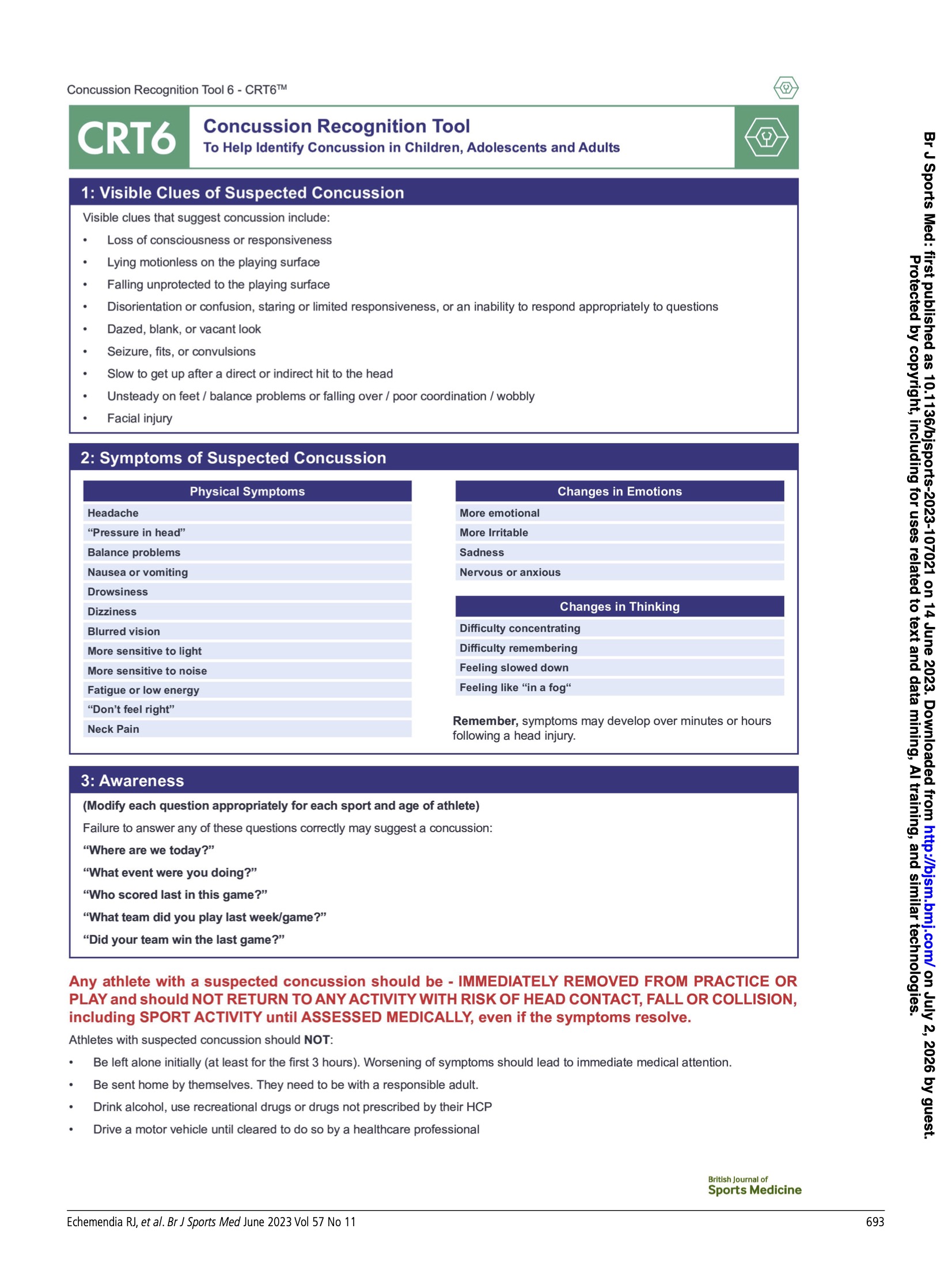
Visible clues that suggest concussion include:
- Loss of consciousness or responsiveness
- Lying motionless on the playing surface
- Falling unprotected to the playing surface
- Disorientation or confusion, starting or limited responsiveness, or an inability to respond appropriately to questions
- Dazed, blank or vacant look
- Seizure, fits ot convulsions
- Slow to get up following a hit to the head
- Unsteady on feet / balance problems or falling over / poor coordination / wobbly
- Facial injury
Symptoms of suspected Concussion
- Physical Symptoms: headache, 'pressure in head', blaance problems, nausea or vomiting, drowsiness, dizziness, blurred vision, more sensitive to light, fatigue or low energy, 'don't feel right', neck pain.
- Changes in Emotions: more emotional, more irritable, sadness, nervous or anxious.
- Changes in Thinking: difficulty concentrating, difficulty remembering, feeling slowed down, feeling like 'in a fog'
First aid treatment of sport related concussion
Any athlete with a suspected concussion should be IMMEDIATELY REMOVED FROM PRACTICE OR PLAY and should NOT RETURN TO ACTIVITY WITH RISK OF HEAD CONTECT, FALL, OR COLLISION, including SPORT ACTIVITY until ASSESSED MEDICALLY, even if the symptoms resolve.
When a player shows any signs or symptoms of a suspected concussion:
- Immediate Removal: The athlete must be immediately removed from play and cannot return to activity on the same day.
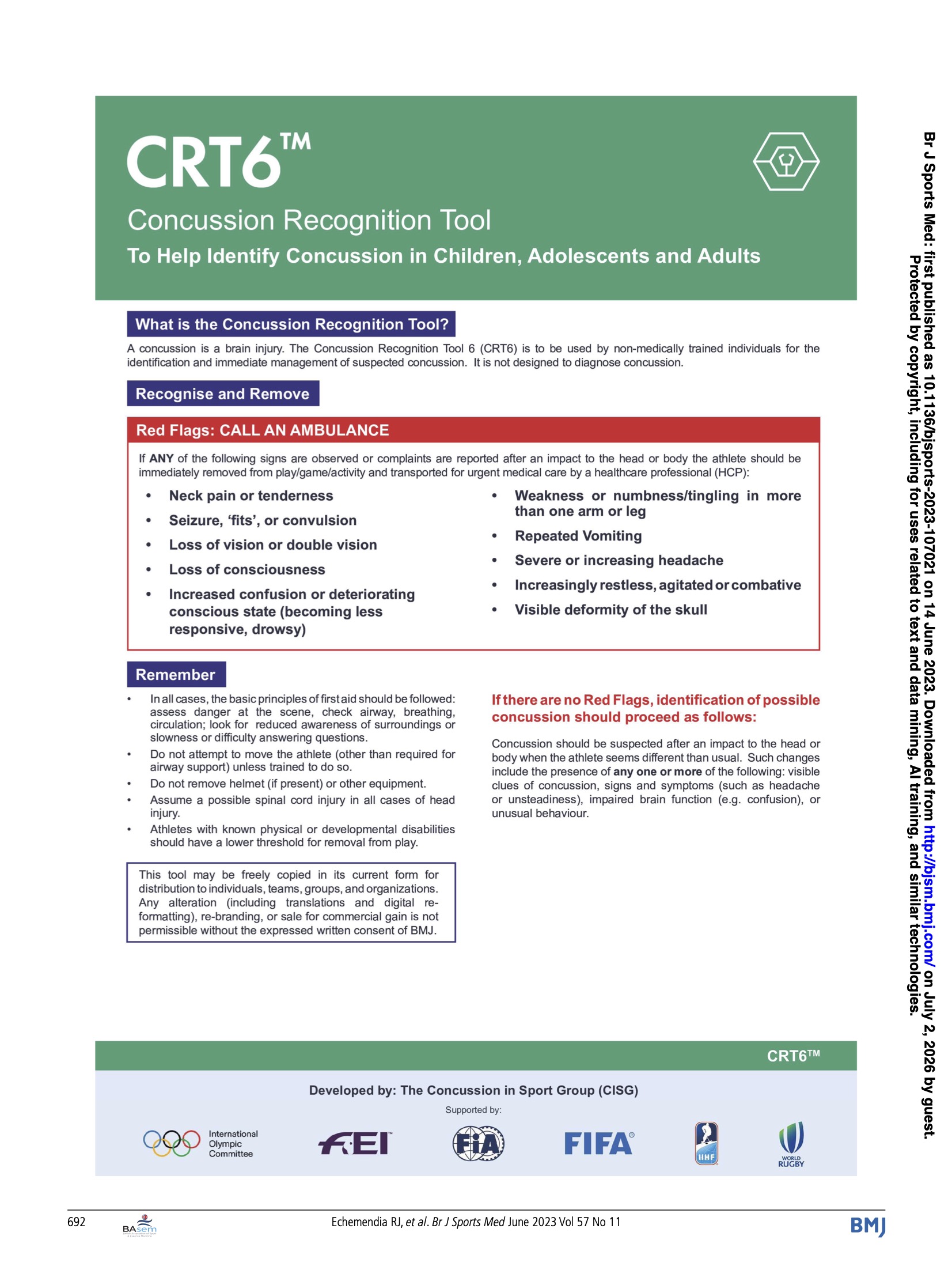
- Red Flags Check: Check for emergency "Red Flags" (e.g., severe/increasing neck pain, double vision, weakness/tingling in arms/legs, severe or increasing headache, seizure, repeated vomiting, or deteriorating consciousness). If any red flags are present, call for emergency medical services immediately.
- they should NOT be left alone initially (at least for the first 3 hours). Worsening symptoms should lead to immediate medical attention.
- the shold NOT be sent home by themselves. They need to be with a responsible adult.
- they shold NOT drive a motor vehicle until cleared to do so by a healthcare professional.
CRT6 – Concussion Recognition Tool
A key concept in sideline assessment is the rapid screening for a suspected SRC, rather than the definitive diagnosis of head injury. The Concussion Recognition Tool, CRT6 is designed to be used by non-medically trainer individuals for the identification and immediate management of suspected concussion.
As a first aider you cannot diagnose concussion however it is also worthwhile to be familiar with the SCAT6 and child SCAT6, concussion assessment tools which are designed for use by medical practitioners to diagnose concussion.
First aiders should use CRT6 to help identify concussion in children, adolescents and adults.
Downloads
CRT6 Concussion Recognition Tool, June 2023
SCAT6 Sport Concussion Assessment Tool, June 2023
Child SCAT6 Sport Concussion Assessment Tool for children ages 8 - 12 years, June 2023
Consensus Statement on Concussion in Sport - 6th International Conference, Amsterdam, Oct 2022
Return to First Aid Tips List
Share this Tip
Related Courses
More Tips
- Continuing to raise the standard of sports first aid training
- Concussion Management in Sports First Aid - CRT6 & SCAT6
- Ski Safe - Top tips to stay safe and injury free when skiing
- The Twelve Safety Tips of Christmas
- Cardiac Arrest in Young People
- Why should I train in first aid?
- Mental Health First Aider Support App - MHFA England
- Why don't we call abdominal thrusts the Heimlich manoeuvre anymore?
- First Aid Course Standard Hygiene Procedures
- What is an Automated External Defibrillator (AED)?


